Home > Colliery
Section under reconstruction

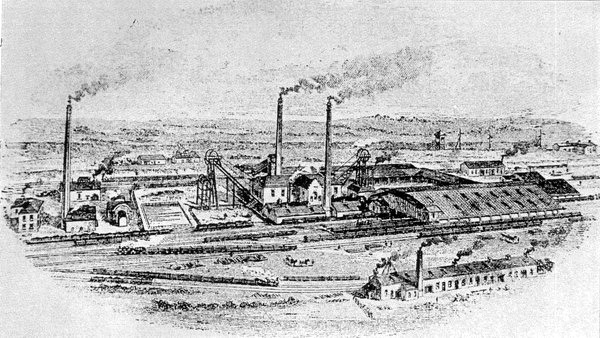
Pleasley colliery - circa 1885, with the Midland railway signal box and station in the background (Stanton and Stavely copyright)
This section explores the history of the colliery itself, its ownership, its development and takes a brief look at various associated personnel.
The principle landowner at Pleasley in the mid 19th century was the Lord of the Manor, W. E. Nightingale, who owned 1159 acre (469.1 ha) out of the total of 1224 acre (495.4 ha) which comprised the manor. He agreed to lease the Top Hard coal lying beneath his land and also a large field known as Round Hill for the construction of the surface buildings. This field had been previously farmed by William Sadler along with other land totalling 197.5 acre (79.9 ha) and it is not known whether he received any compensation for the loss of use of this substantial piece of fertile land. In addition a narrow strip of land was leased along the eastern edge of the fields between Round Hill and Newboundmill Lane to the south for the construction of an access road together with a few other small pieces of land for colliery houses and ancillary buildings. Another narrow strip to the north and part of the adjacent field to the west were leased to the Midland Railway for their branch line extension from Teversal and for the colliery sidings.

1847 tithe map of part of Pleasley township showing the field where the colliery was later built, the route of the Midland railway extension from Teversal and the line of the Back Lane access.
Construction:
The actual commencement date is unclear, but the lease was apparently signed in September 1872 and it is likely that preparations would have been in hand to commence work immediately. Although the ownership details given by more recent sources are somewhat confused, contemporary records show that the colliery was owned by the Stanton Iron Company, later incorporated as the Stanton Ironworks Company Ltd.
The total cost, including housing was no more than £100,000, (about £4.5 million in today’s prices), but the sinking took six years to complete due to technical difficulties and the economic recession which began in 1873.
|
Water supply: Copious quantities of water were encountered during the sinking and this would normally have been tapped in order to provide a supply for the pit. Unfortunately it was found to have a very adverse effect on the boilers and an alternative supply had to be found. In 1892 the water supply for the pit was being provided by a steam driven pump located in an engine-house near the Horse-Fair spring although it’s not clear just how the water was extracted from the spring itself. By 1900, this engine-house had been demolished and replaced by another building situated on the banks of the river about 150 yd (138 m) away. A small weir was erected across the river to create a reservoir with a channel, protected from larger debris by a steel grill, feeding stilling tanks near to the pump-house which removed suspended sediment. From there it was drawn into the pump-house where a Tangeys vertical boiler supplied steam for two Tangeys “Special” ram pumps which pumped it up to a reservoir near the ventilation fans - one pump always being kept on stand-bye. By the 1960s two electrically driven turbine pumps were in use instead. Electrification: Pleasley Colliery was electrified at an early stage. In 1881 experimental use of incandescent lamps on the coal face took place. This was subsequently followed by the permanent installation of this type of lighting in the pit bottom and carbon-arc lighting on the surface. In 1890 a 84kW DC generator driven by a horizontal steam engine was installed near to the ventilation fans. This operated at 500 Volt, supplying the surface and underground lighting and powering a 60 hp (45 kW) haulage engine located near the pit bottom in the Top Hard seam. Transport: Prior to the arrival of the railway, all transport would have been by road. In 1741 the main alternative to the Great North road running via Nottingham to Rotherham and Barnsley passed through Pleasley. The 19th century Pleasley to Rotherham turnpike branched off the Mansfield to Chesterfield road a few hundred yards to the north-east of the colliery which suggests that the main roads were of a good standard. At the start of the sinking, the back lane access from Newboundmill Lane was created on the west side but subsequently a pre-existing lane serving an old windmill on the east side became the main entrance to the colliery Chesterfield Road. Landsale wharfe was soon constructed there to serve the local area. By 1875 the colliery had been reached by the Midland Railway Company’s excavations for the Tibshelf to Pleasley extension from the Erewash Valley main line at Westhouses. It was April 1877 when the line officially opened for mineral traffic ready to carry Pleasley coal up the ?? mile steady climb past Teversal to the watershed at 600 ft ready for the ?? mile downhill run to the main line at ?? ft followed by ?? mile of easy going down the Erewash valley to the blast furnaces just South of Ilkeston. In 1887 the line was extended via Pleasley Vale to link up with the Midland Railway line at Mansfield Woodhouse giving Pleasley coal direct access to Mansfield itself and many new markets further towards the East coast. In March 1898 the Great Northern Railway’s Lean Valley Extension opened for mineral traffic providing a second route to Stanton Ironworks along the easy gradients through Skegby, Newstead and Hucknall to Basford and then Kimberly. |
|||
Housing:
It’s not clear where the workers were living during the sinking. The 1875 1:2500 map shows a single row of buildings on the LH side of what is now Terrace Lane to the south-west of the pit. This was the location of a small block of stone-built terraced houses on what was known as the Old Terrace. Contemporary accounts indicate that by 1879 the rest of the red brick houses on Old Terrace had been constructed, together with houses for the main officials near to the pit yard.
By 1891 further houses had been built at Pleasley Hill and New Houghton for the steadily expanding workforce and the population had increased to 3293.
Sources
Copyright © 2005 - 2020 J.S. Thatcher
Page updated on:
10 Dec, 2025
at
02:25:50 PM
In case of problems contact: