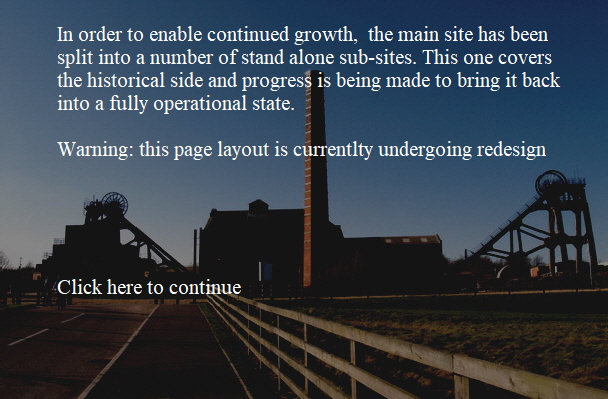
Section under development
Contents:
|
On these pages we take a brief look at the history of the village of Pleasley, a more detailed look at the history of the colliery itself, including ownership, development and personnel, together with a look at the mining technologies used during the life of the colliery. First, however, a brief outline of the economic context around that time is necessary.
The great Victorian boom and depression: Following the successful sinking of Teversal colliery in 1868 the decision to sink a colliery at Pleasley was probably made sometime in 1871-72, the lease was negotiated in 1872 and construction began in 1873 yet more than 6 years elapsed before production actually commenced. Although the economic climate had been good when the sinking started it soon began to decline. Economically, the second half of the 19th century is traditionally divided into two periods. The years 1850 -73 have been called the “great Victorian boom” and the years 1873 - 96 the “great Victorian depression”. Modern economic historians regard these terms as oversimplifications, with analyses showing that, throughout this period, some sectors were growing whilst at the same time others were stagnating or experiencing a slump. It is generally agreed, however, that there was a definite strong cyclic upturn in the years 1868 - 72, with business confidence high and capital in good supply, whilst after 1873 the British economic growth slowed in a number of key aspects such as industrial growth, productivity and exports. During this time demand fell, business confidence declined and capital was in short supply. |
|||
![]() |
|||
The 1872 “coal famine” and its aftermath:
During the first half of the 19th century the coal output in the UK had increased dramatically. At the start of the century, the principle coalfields were in Durham and Northumberland and in 1816 they produced 15,500,000 tons. By 1835 this had increased to 29,400,000 tons and other coalfields were starting to be developed. By 1855, the output from all the UK coalfields had reached 60,000,000 tons and in 1864 it had climbed to 92,800,000 tons.
This dramatic increase in production came largely from collieries located in the areas of the exposed coal fields and by the end of the 1860s concern was growing as to the country’s ability to maintain the growth in demand for coal resulting from the expansion of British industry and commerce.
A royal commission was set up to inquire into the extent of the reserves and in 1871 had reached the alarming conclusion that they were quite limited. This led to a panic and coal prices increased dramatically so that by 1873, coal which had earlier fetched 17s-6d to 25s per ton was now costing at least 50s per ton. Coal owners, merchants and carriers exploited this to the hilt.
A parliamentary select committee set up in 1873 to investigate whether the cause of the increase was due to the miners combining to demand higher wages found that whilst the miners were demanding their share of the increased profits and a number of large strikes had occurred, there were a number of other, more direct, factors involved:
These factors came together in 1870-71, draining the stocks held at the collieries and leading to a “coal famine”. In addition, the coal owners passed on the cost of the recently introduced humane coal mining legislation directly to the customer. It was these factors, together with the panic over the earlier estimates of the reserves by the Royal Commission which were the actual cause.
Meanwhile a reaction to the inflation occurred. Exploration of the concealed coalfields began to accelerate and new highly productive collieries with modern facilities were sunk. Dramatic increases in fuel economy were achieved in iron manufacture, industry and steam engine performance etc. Prices began to fall, and by 1883, coal costing 50s / ton in 1873 was now only 25s / ton. By the following year the prices were, in many cases, lower than they were before the price rises started.
UK coal production in 1883 was 157,000,000 tons, almost 23,000,000 tons of which was exported, including 6,400,000 tons of steam coal to British coaling ports across the globe.
Sources:
Copyright © 2005 - 2020 J.S. Thatcher
Page updated on:
10 Dec, 2025
at
02:25:50 PM
In case of problems contact: