Pleasley township (1843)
- Rector: Rev Richard Holden
- Advowson (right of appointment of Rector): William Pole Thornhill
- Lord of the Manor: W. E. Nightingale
- Arable land : 748a 0r 6p (WEN)
- Meadow and Pasture : 163a 2r 20p (WEN)
- Woodland: 218a 0r 14p (WEN)
- Roads and sites of houses: 39a 1r 16p (WEN)
- Glebe land (church etc): 55a (RRH)
- Tithes:
- calf = 3d
- bee swarm = 1d
- pig litter 1 - 5 = 1/2 pig
- pig litter 6 - ? = 1 pig
- lambs 1 - 4 = no thithe
- lambs 5 - ? = same as pigs
1851
- “Pleasley parish contained 126 houses and a population of 654. W.E. Nightingale was Lord of the Manor and principle landowner at Pleasley township.”
1874
- Jan 10th. W.E. Nightingale dies in a fall downstairs at his home in Embley. Pleasley Manor then passes to his daughter Parthenope, now married to Sir Harry Verney.
1881
- The population was 1152.
In the 19th century :
Just prior to the start of the sinking of the colliery in 1872, Pleasley was a small decayed market town. The market itself was no longer held but the two annual fairs were still active.
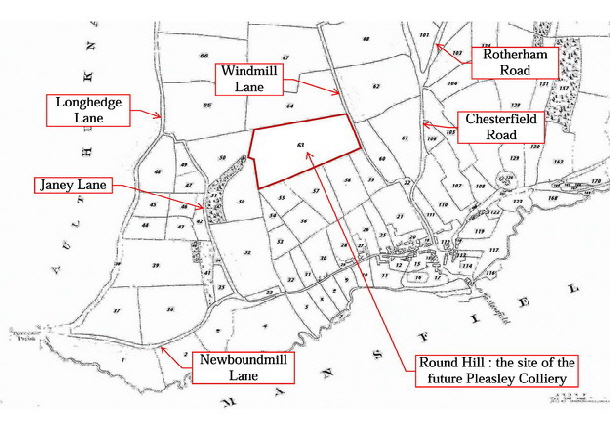
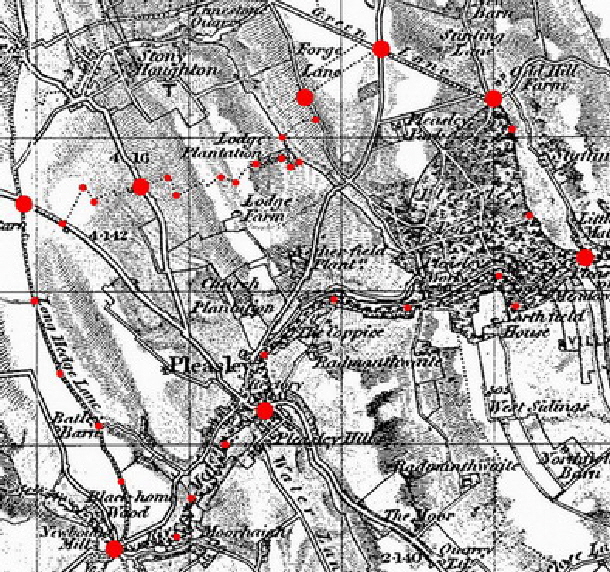
Pleasley manor’s boundary can be traced as a feint dotted line starting from Newboundmill Bridge over the river Meden.
Part of Pleasley manor Tithe map circa 1845
1803
- Coal proved by a borehole 1/4 mile north of Pleasley bridge.
- Hollins Co. install a Boulton and Watt steam engine in the lower mill in Pleasley Vale
1809
- Bache Thornhill gives Pleasley Manor to his eldest son - Henry Bache Thornhill (who had married Helen Pole in 1801)
1811
- Pleasley parish (Pleasley, Shirebrook, Stoney Houghten) contained about 90 houses
1816
- Sunday, March 17th. Earthquake felt throught the East Midlands causes large crack in tower of St Michael’s church in Pleasley
1821
- Henry Bache Thornhill makes a will - which included his fathers estate in anticipation of his future inheritance.
1822
- Henry Bache Thornhill dies but his father is still alive and Pleasley Manor has to be sold in order to provide for his wife and family.
1823
- Pleasley Manor auctioned at the Swan Inn, Mansfield and purchased by William Edward Nightingale for £38,000 - with the exception of the two cotton mills, their dams and 15 acres of land in Pleasley Vale - these were still under lease to Hollins Co.
1824
- Sale of Pleasley Manor to W. E. Nightingale completed.
1828
- The two cotton mills, their dams and 15 acres of land in Pleasley Vale were bought by the Hollins Company for £7,600 when the lease expired.
1839
- Hollins Co. purchase a “gas apparatus” in order to produce their own gas light for the Pleasley Vale mills. They later supplied gas to Pleasley Colliery and to Pleasley village.
1840
- Hollins’ upper mill in Pleasley Vale destroyed by fire on Dec. 25th.
1844
- Hollins’ lower mill in Pleasley Vale destroyed by fire during the summer.
Pleasley manor circa 1840
Sources
- Agriculture of Derbyshire Vol 1 J. Farey 1811
- Pleasley - a description from Pigot’s directory 1835
- Whites 1857 directory of Derbyshire Parishes
- Pleasley - extract from National Gazetteer 1868
- The Andrews Pages: Kelley Directory, 1891
- The Andrews Pages: Derbyshire Parishes
- Hollins, A Study of Industry 1784-1949, Stanley Pigott 1949
- 1843 Tithe Map and Allocations, Derbyshire Records Office, Matlock
- Parishes: Packington - Repton', Magna Britannia: volume 5: Derbyshire (181 pp. 228-46
Part of Pleasley Parish tithe map 1843
Village > 1800-1870

Section under reconstruction



Page updated on:
07 Jul, 2026
at
12:10:05 PM
In case of problems contact:
Copyright © 2023 J.S. Thatcher
