1945 - 50
- production recommences in the Deep Hard seam from new panel workings on both the south and north sides of the shaft with modern power loading machines introduced on the coal face
- production continues from the Top Hard, Dunsil and 1st Waterloo seams
- the coal industry is nationalised and plans are drawn up for the modernisation of the colliery :
- North pit:
- the shaft is deepend to the 2nd Waterloo seam level and a new pit bottom designed for use with coupled mine-car trains is constructed
- a 1 km long haulage road for battery-loco hauled mine-car trains is driven in the 2nd Waterloo seam and a new loading point for the Dunsil and 1st Waterloo coal is constructed
- on the surface, an enclosed heapstead containing a mine-care circulation and tippler circuit is constructed to enable automatic single mine-car handling operations
1950s
- South pit:
- a new pit bottom designed for use with single uncoupled mine-cars is constructed
- a 500 m long mine-car circulation road is driven on the east side of the shaft and a new loading point for the Deep Hard and the planned 1st Piper seam coal is constructed
- on the surface, major extensions to the heapstead air-casing to hold a mine-care circulation and tippler circuit is constructed to enable automatic single mine-car handling operations
- production from the south-side Deep Hard seam ends but expands from the north-side
- production from the Top Hard seam ends but expands from the Dunsil, 1st Waterloo seams
- the opening-up work to the 1st Piper seam begins from the Deep Hard roadways on the south side of the shaft
1960s
- the colliery electrical power is taken from the National Grid.
- the 1915 DC generator discontinued and its power-house demolished
- the 1924 turbo-alternator discontinued and removed from main power-house
- production from the 1st Piper seam begins
- production from the Dunsil seam diminishes
- production from north-side Deep Hard seam diminishes
- production from the Dunsil seam ends
1970s
- production from the 1st Waterloo seam ends
- coal winding at the North pit ends
- production recommences from the south-side Deep Hard seam
- inspection of the North and South pit headstocks find these to be badly corroded and in a dangerous condition
- the steelwork of both headstocks is encased in concrete to reinforce the structure
- production from the Piper seam ends
- development of the combined Deep Hard / Piper seam begins
1980s
- Production expands from the combined Deep Hard / Piper seam on E side of workings
- Underground coal transport routed through to Shirebrook colliery
- coal winding at the South pit ends
- man winding at the South pit ends
- Closure of the colliery
- North shaft filled and capped
- Washery adapted for pit tip recycling operation
- Demolition of the washery, surface infrastructure, buildings etc
- South shaft converted to a downcast providing air for Shirebrook workings
- Emergency listing of engine-house complex.
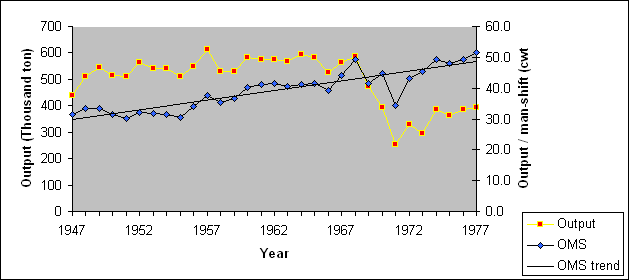
1947 - 1977 production levels and output per manshiftt
Colliery | Development > 1945 - 1986
Section under development



Page updated on:
31 Dec, 2025
at
02:23:13 PM
In case of problems contact:
Copyright © 2023 J S. Thatcher
